WHY SLOW UP


.avif)
.svg)
You’re exhausted? Get better at managing your time.
You never have enough time for your children? Organise your life more efficiently.
You’re stressed? Take some time for yourself.
You can’t make ends meet? Spend your money more wisely.
You feel lonely? Make more of an effort to connect.
There’s plastic everywhere? Use a paper straw.
The climate is changing? Reduce your personal footprint.
We’ve become very good at treating collective problems as personal ones.
Even when we are not working, we are being encouraged to consume, respond, optimise and keep up. Work follows us home through emails and messages late into the evening. Our phones keep buzzing with WhatsApps, notifications and news. Schools and childcare are under pressure, while parents are expected to keep everything running. And even our free time is increasingly filled with things to do, places to be and products to buy. We are constantly asked to do more, respond faster and make better use of every minute. When we feel overwhelmed, the solution is often presented as another individual task: manage your time better, set better boundaries, practise better self-care.
What if the problem isn’t that we need to manage our time better, but that there is simply too much asking for it?
What if loneliness is not only about individual choices, but also about living in a society where everyone is busy, busy, busy trying to keep up?
What if the planet’s ecological limits cannot be solved by making slightly better individual choices while the system keeps demanding more production, more consumption and more growth?
We live in a culture of “harder, better, faster, stronger.”
More, always more.
Somewhere along the way, we seem to have forgotten what enough means.
And we are paying the price. People are exhausted. Burnout and loneliness are widespread. Time for care, connection and rest is unevenly distributed. And while we keep pushing ourselves further, we are pushing the planet beyond its limits too.
There is no work-life balance on a dead planet.
There is no wellbeing on a dead planet.
There is no music on a dead planet.
We often treat human wellbeing and the health of our planet as separate concerns. But they are deeply connected. We need a liveable planet to live well. Taking care of ourselves cannot only mean finding better ways to cope with a system that keeps asking more of us. It also means asking whether we can organise that system differently.
These crises are connected. And they are not simply individual failures
There is no wellbeing on a dead planet.
There is no music on a dead planet.
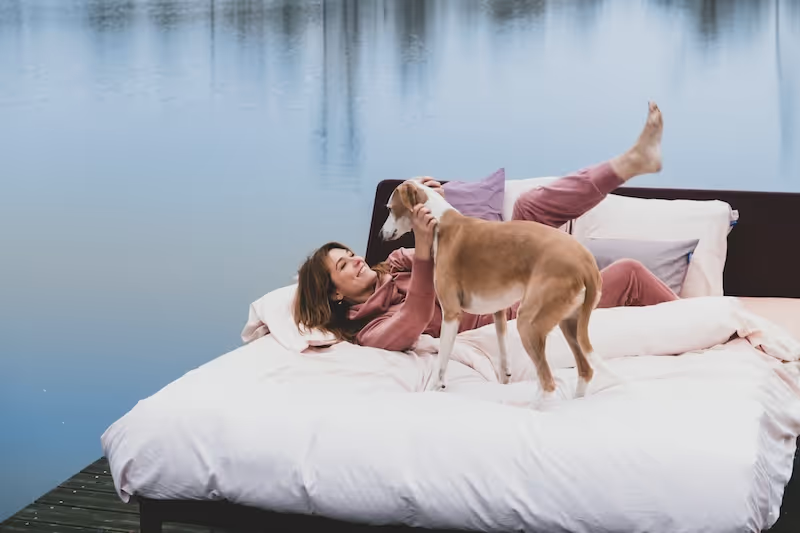
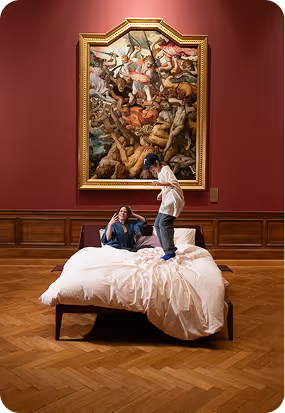
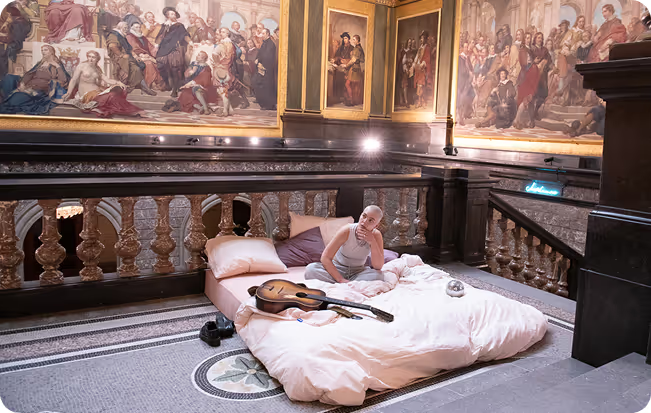
On 24 and 25 October 2026, as we move into winter time, we take 25 hours to pause. Inspired by the bed-ins of John Lennon and Yoko Ono, we turn rest into a collective act.
Because the question is not only: who needs a break?
It is also: who gets to rest?
Who decides what counts as productive?
Who benefits from a world in which everyone must always be available, productive and consuming?
And what could our lives look like if we organised them differently?
We believe activism can be loud and urgent. But it can also be quiet, joyful and inviting. Slow Up belongs to that softer spectrum. Not because the problems we face are soft, but because we want to create space to imagine something different.
A society where wellbeing matters as much as growth.
Where people and planet have room to recover.
We organised our lives this way. We can organise them differently.
A liveable future is possible.
If we want it.
If we want it.
Ready to slow Up?
Join the movement
.avif)