Founder Elisabeth Van Lierop
Sustainability is too often framed as something for left-wing, “woke” cargo-bike moms.
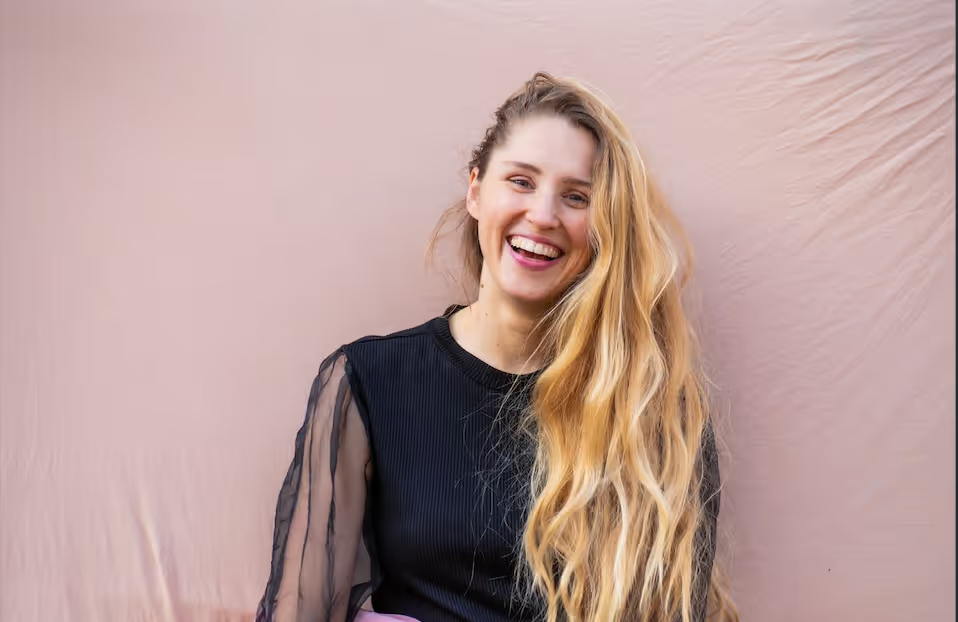
Elisabeth Van Lierop is the founder and initiator of Slow Up for Humanity, and previously organized Show Up for Humanity in 2025 and 505 Concerts for Humanity in 2024. Her work moves at the intersection of storytelling, sustainability and collective wellbeing, exploring how cultural narratives shape the way we live, consume and relate to one another in an increasingly accelerated society.
She reflects on the urgency and complexity of today’s challenges:
“Sustainability is too often framed as something for left-wing, “woke” cargo-bike moms. Yet research shows that most people genuinely want to do their best for each other and for the planet. And still, Burnout, mental health issues, and loneliness are on the rise. At the same time, we are exhausting the planet: Belgium’s overshoot day falls as early as April, PFAS is in our water, air quality is poor, plastic fills the oceans, ice caps are melting, and 7 of the 9 planetary boundaries have already been crossed.
We keep rushing past one another. We hurriedly drop our kids off at overcrowded daycares and schools, always in a rush, soothing our guilt by buying things we don’t really need, often made in inhumane conditions. The constant demand for availability, productivity, and consumption is draining us, straining our relationships, and depleting the planet.
This cannot remain a left-versus-right debate. It concerns all of us. Maybe it’s time to question who actually benefits from endless growth, from speed over care, from efficiency over humanity.
One day of slowing down won’t fix this. But it can be a reset. A moment to reflect on what truly matters, and to reopen the conversation about wellbeing for everyone, instead of growth for a few.
The real question is: how do we come together to build a livable future and a more humane society?”
Slow Up for Humanity builds on this idea: that slowing down, even briefly, can create space to step outside default narratives and ask better questions about the systems we live in.
“Duurzaamheid wordt te vaak geframed als iets voor linkse woke bakfietsmoeders. Terwijl uit onderzoek blijkt dat de meeste mensen eigenlijk wel hun best willen doen voor elkaar en de planeet. En toch blijven we onszelf voorbij hollen, duwen we onze kinderen ‘s ochtends snel snel uit de auto bij een overvolle crèche of school, altijd gehaast, kopen we ons schuldgevoel af met spullen die we niet eens écht nodig hebben, vaak gemaakt in onmenselijke omstandigheden. Burn-out, mentale klachten en eenzaamheid nemen toe. Tegelijk putten we de planeet uit: de Belgische overshoot day valt al in april, PFAS in ons water, slechte luchtkwaliteit, plastic in de oceanen, ijskappen die smelten en 7 van de 9 planetaire grenzen zijn overschreden.
De constante druk om altijd beschikbaar, productief en consumerend te zijn, put ons uit, zet onze relaties onder spanning en tast de planeet aan. Dit mag geen links-rechtsverhaal blijven want het belangt ons allemaal aan. Wordt het geen tijd dat we stil staan bij wie er baat heeft bij eindeloze groei, snelheid boven zorg, efficiëntie boven menselijkheid. Eén dag vertragen lost dit niet op. Maar het kan wel een reset zijn. Een moment om stil te staan bij wat we echt belangrijk vinden, en om het gesprek te heropenen over welzijn voor iedereen, in plaats van groei voor enkelen.
De echte vraag is: hoe zorgen we samen voor een leefbare toekomst en een menselijkere samenleving?”
Read other stories

.avif)



.svg)