Why We Believe in Soft Protest
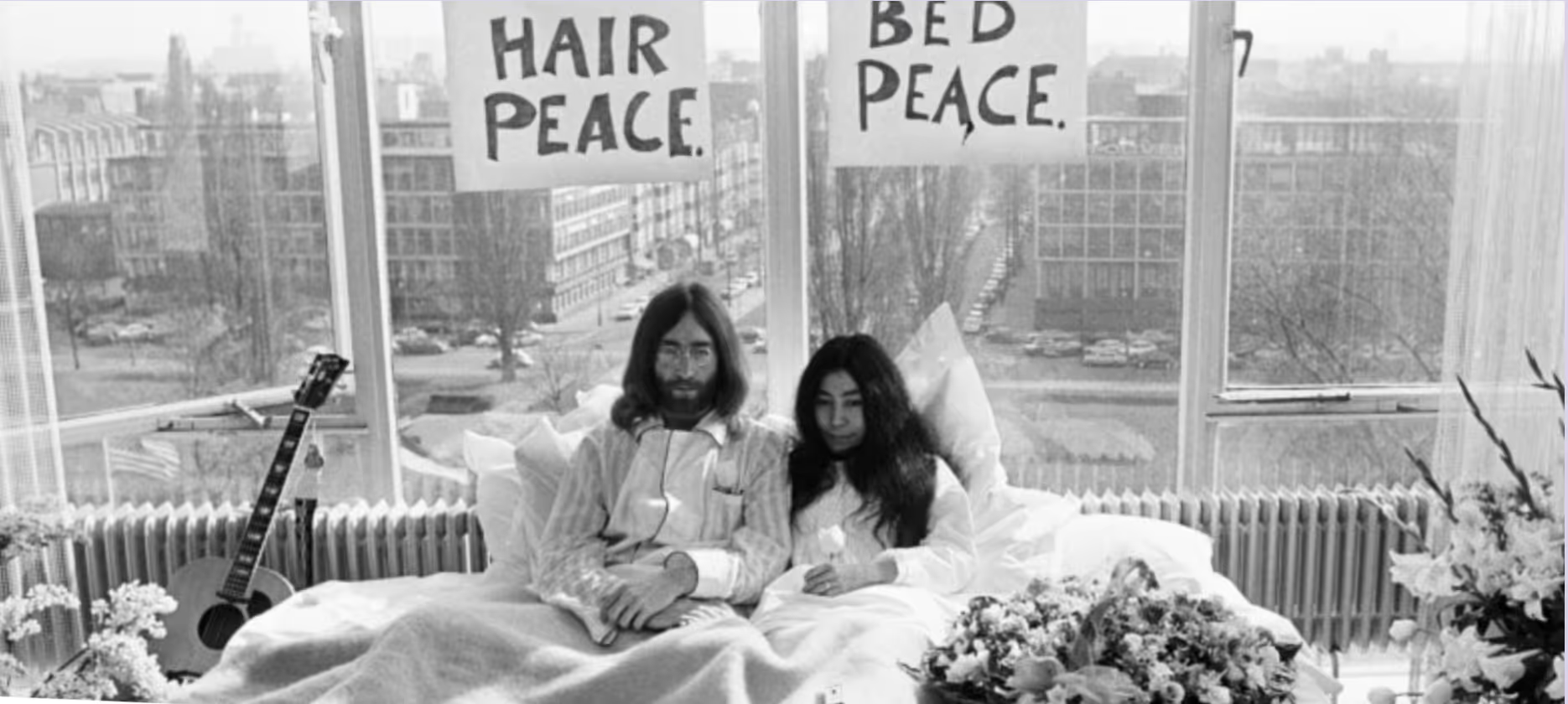
The choice is a deliberate reference to John Lennon and Yoko Ono's Bed-In for Peace in 1969.
Why Slow Protest Matters
Contemporary protest is often associated with urgency. Marches, petitions, strikes and acts of civil disobedience are designed to disrupt the status quo and force neglected issues into public debate. Yet not every societal challenge lends itself to confrontation alone. Some problems are so deeply embedded in everyday life that they require a different form of resistance.
Slow Up emerges from a growing awareness that two seemingly separate crises are in fact closely connected: the ecological overshoot of our planet and the increasing exhaustion of its inhabitants. While environmental scientists warn that we are exceeding multiple planetary boundaries, rising rates of stress, burnout and mental health problems suggest that many people are experiencing their own limits as well.
Both phenomena are linked to a culture organised around "never enough". Economic success is largely measured through growth, productivity and consumption. Technological innovation has enabled unprecedented efficiency, yet many people report feeling that they have less time rather than more. Sociologists such as Hartmut Rosa have described this as a defining characteristic of modern life: as society accelerates, individuals are required to continuously adapt, perform and keep up.
The question Slow Up for Humanity poses is therefore not merely environmental or psychological. It is cultural. What happens when a society loses its capacity to pause?
To explore that question, we adopt an unusual symbol: the bed.
The choice is a deliberate reference to John Lennon and Yoko Ono's Bed-In for Peace in 1969. At a time when protest was often associated with confrontation in the streets, Lennon and Ono chose radical simplicity. They remained in bed and invited journalists, artists and activists into a conversation about peace.
Reflecting on the action afterwards, Lennon explained:
"We decided to utilize the space we would occupy anyway with a commercial for peace. We're selling our product, which we call 'peace'. And to sell a product you need a gimmick, and the gimmick we thought was 'bed'. And we thought 'bed' because bed was the easiest way of doing it, because we're lazy."
Beneath the irony lies an important insight about social change. Not all protest seeks to block, confront or oppose. Sometimes it seeks to reframe. By turning an everyday object into a political symbol, Lennon and Ono challenged assumptions about what protest could look like.
The aim is not to celebrate passivity. Nor is it to romanticise withdrawal from public life. Rather, it is to create a temporary space in which alternative values can be explored. What if rest were understood not as a reward for productivity, but as a precondition for wellbeing? What if slowing down were recognised not as an individual luxury, but as a collective necessity in a society facing ecological limits?
By inviting people to slow down for 25 hours during the transition to winter time, Slow Up for Humanity proposes a modest but symbolic intervention. It asks participants to reflect on their relationship with time, consumption and attention, while also acknowledging the finite limits of the natural systems upon which all economic activity ultimately depends.
Whether such gestures can lead to lasting change remains an open question. Yet social movements have long relied on symbols to make complex realities tangible. In a culture defined by speed, the simple act of slowing down may itself become a meaningful political statement.
Read other stories

.avif)



.svg)