Waarom wij geloven in zacht protest
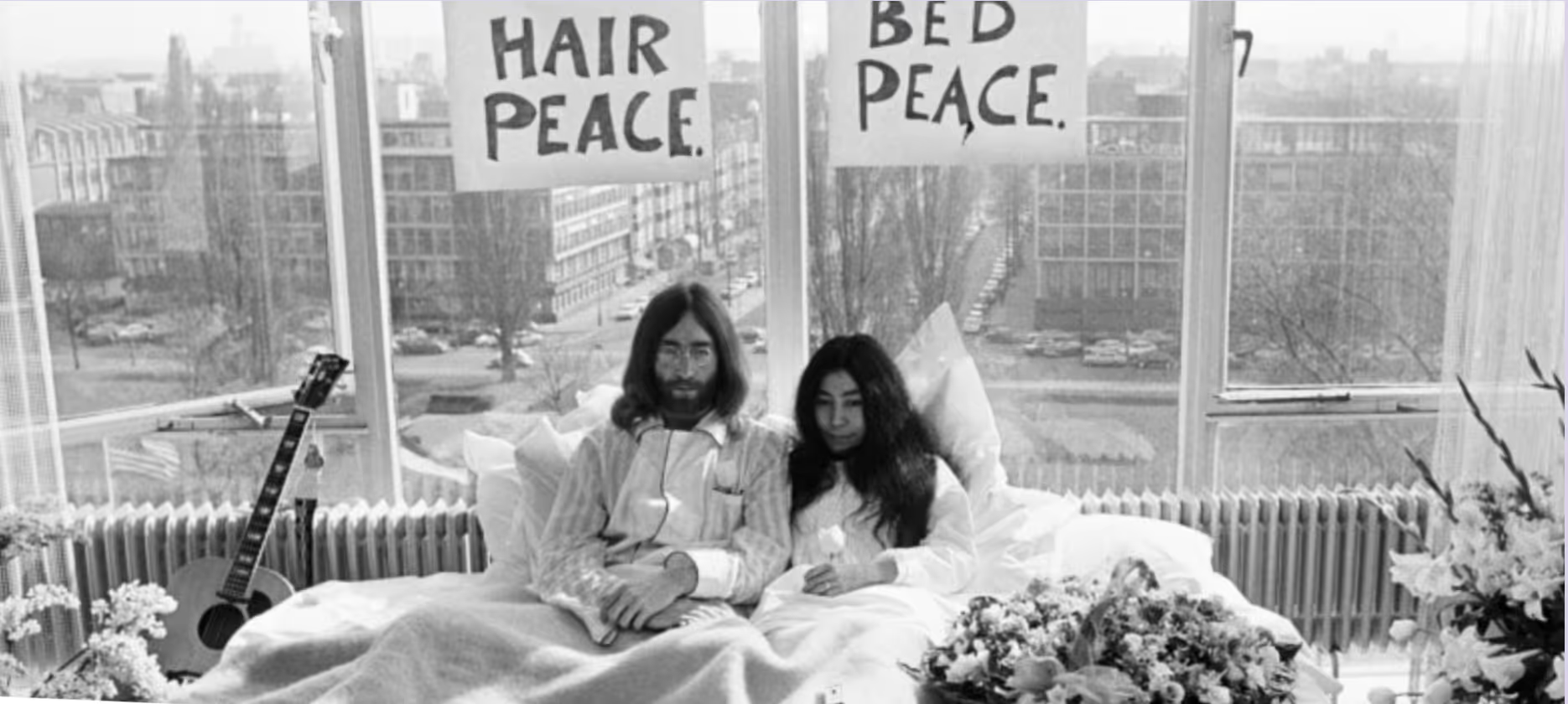
Deze keuze is een bewuste verwijzing naar de ‘Bed-In for Peace’ van John Lennon en Yoko Ono in 1969.
Waarom langzame protesten belangrijk zijn
When we think about protest, we tend to think about urgency. Marches, strikes, petitions, civil disobedience, people standing on barricades: ways of interrupting the ordinary rhythm of things and making an issue impossible to ignore. And there are moments when that kind of protest is essential. On 11 October, we will join the climate march in Brussels, and we will take part in the KLIMAATZAAK ALL RISE action. Sometimes you need to stand up, take legal action, march the streets and make your voice heard.
But social change rarely comes from one kind of action alone.
Revolutions need people who are willing to push hard against the boundaries of what is considered possible or acceptable. People who refuse to wait for permission, who disrupt the status quo and make visible what others would rather leave untouched. They can shift the edges of the conversation, sometimes far beyond what seemed realistic only a few years before.
At the same time, change also needs people who build bridges. People who find ways to make difficult ideas accessible, who create spaces where people can enter without already being activists, and who invite someone to take a first step. Not everyone will start by standing on a barricade. Sometimes the first step is much smaller: showing up, asking a question, having a conversation, trying something unfamiliar.
We need both.
Some movements push from the edges. Others create a path towards the centre. Some make noise. Others create curiosity. Some demand immediate change. Others help people imagine themselves as part of that change.
We are choosing the second role with Slow Up. We are interested in what happens when an invitation is gentle enough for people who would never describe themselves as activists to join in. But that does not mean we believe gentle protest is the only kind that matters. Quite the opposite. We think every form of protest has its place, and that movements become stronger when different approaches can exist alongside one another.
This is also where the idea of the slow protest comes from.
We are pushing against planetary boundaries while pushing ourselves to work faster, respond sooner, consume more and remain permanently available.
So perhaps protest can also take the form of questioning the rhythm itself.
This idea has a rather famous precedent.
In 1969, John Lennon and Yoko Ono staged their Bed-In for Peace at the Amsterdam Hilton. At a time when protest was strongly associated with confrontation and demonstrations, they chose something almost absurdly ordinary: they stayed in bed. They invited journalists, artists and activists into their room and turned the bed into a place for conversations about peace.
Lennon was well aware of the playful absurdity of the gesture. Looking back on the Bed-In, he explained that they wanted to use the space they would occupy anyway as a kind of advertisement for peace. The bed was the gimmick. It was simple, recognisable and impossible to take completely seriously, which was precisely part of its power.
The Bed-In did not replace demonstrations against the Vietnam War. It did something different. It expanded the vocabulary of protest.
That matters. Because protest is not only about opposing something. It is also about inventing new ways of seeing. A revolution in the streets may change laws and institutions. A strange image, a song, a conversation or a bed in a hotel room can sometimes change what people imagine to be possible.
This is where we see the value of gentle protest. It is not a retreat from political action, and it is not an argument for replacing radical activism with individual wellbeing. It is another tool in the toolbox.
On 24 and 25 October, Slow Up will use that familiar object as a small political gesture: a way of asking what happens when we deliberately interrupt a culture organised around speed. For 25 hours, people across Belgium can choose to stay in bed, read, walk, talk, cook, play with their children, put their phones away or simply leave some time deliberately unfilled.
It is a modest act. We do not expect a weekend of slowing down to solve the climate crisis or transform the economy. That is not the point.
The point is to practise another possibility, and to make it visible.
Because every movement for change needs imagination. It needs people who are willing to stand up and people who are willing to make room. It needs urgency and patience, confrontation and conversation, barricades and bridges.
We need people on the barricades. We need people building bridges. We need those who disrupt, those who organise, those who persuade, those who create, those who refuse and those who invite.
Sometimes you stand up.
Sometimes you stay in bed.
Both can be part of a revolution.
Lees andere verhalen